Data recording triggered by lightning
A reliable trigger is the cornerstone of every event-driven lightning observation system. Recording the full waveform of a thunderstorm is technically infeasible: a single SDR receiver at 10 MS/s on multiple channels produces data faster than it can be written to storage, and the latency of flushing a captured fragment to disk creates dead time during which no further event can be acquired. The trigger therefore decides both what and when the instrument records.
This page documents the trigger methods that the RSMS systems use and replace, together with the measurements that motivated the final design.
Trigger requirements
For research-grade lightning observation in the field, a trigger has to combine several properties:
- High true-positive rate even in electromagnetically noisy environments (highways, urban areas, switching power supplies on the measurement vehicle).
- Low false-positive rate, because every false trigger wastes the dead time window.
- Operation in stand-alone mode (no network connection required, no central server).
- Mobile deployment (low power, vibration tolerance, fast warm-up).
- Output suitable for distribution to several downstream instruments (cameras, EFM logger, radiation detectors).
These constraints rule out the most widely used signal-amplitude threshold (too many false positives in noisy environments) and at the same time the most physically accurate matched-filter detector (lightning waveforms are time–space random, so no usable template exists). The practical compromise is an energy-based detector.
Energy-based detection
For a signal $s(t)$ on the interval $[t_1, t_2]$, the signal energy is
\[E = \int_{t_1}^{t_2} |s(t)|^2 \, dt ,\]and an event is declared whenever $E > E_\mathrm{th}$. In discrete time with sample period $\Delta t$, this becomes
\[\sum_{0 \le i < N} |s(t_1 + i\Delta t)|^2 \Delta t > E_\mathrm{th}.\]The RSMS02 receiver uses a hardware-friendly approximation: count the number of consecutive samples whose absolute value exceeds an amplitude threshold $A_\mathrm{th}$, and trigger when this count reaches $N_\mathrm{min}$:
\[\forall i,\, 0 \le i < N_\mathrm{min}\!:\; |s(t_1 + i\Delta t)| > A_\mathrm{th}.\]This is a Time-over-Threshold (ToT) detector. It is a lower bound on the energy detector, since
\[\sum_{0 \le i < N_\mathrm{min}} |s(t_1 + i\Delta t)|^2 \Delta t \;\ge\; N_\mathrm{min} A_\mathrm{th}^2 \Delta t .\]Compared with a pure amplitude threshold, the ToT version is robust against isolated noise spikes. Compared with a full energy detector, it is far cheaper to implement: the FPGA only needs a comparator and a counter, no multiplications. The RSMS02 firmware implements this trigger directly in VHDL — see the threshold_detector module in the receiver firmware repository.
The exposed configuration parameters are: ADC channel selection, amplitude threshold (16-bit unsigned), minimum duration (in samples), trigger pulse shape (on/off times for downstream instrument compatibility). Two independent trigger channels run in parallel so a single station can produce two triggers with different selectivity (e.g. one tuned for nearby lightning, one for distant flashes).
Why not a commercial chip?
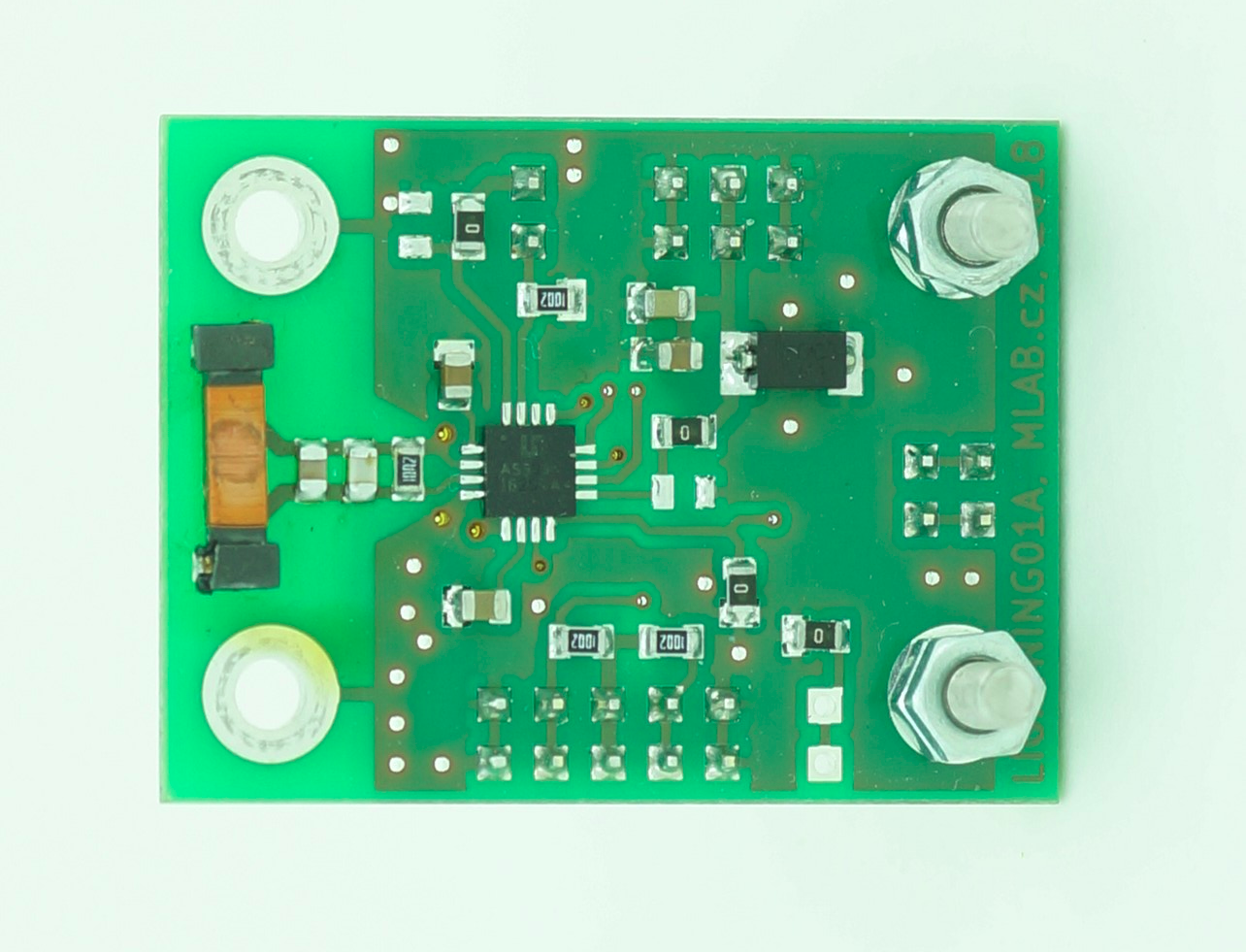
Before adopting the SDR-based approach, the AMS AS3935 integrated lightning sensor was evaluated as a candidate trigger source. The AS3935 implements a proprietary internal classification algorithm and a tuned 500 kHz coreless coil antenna (MA5532-AE). The chip outputs one of three classifications per event: lightning (DIVIS8), disturbance (DIVIS4), or high-noise (1).
The MLAB module LIGHTNING01A carries this circuit:
The complete data logger built around LIGHTNING01A (with a DATALOGGER01A, GPS receiver, pressure sensor, primary lithium-thionyl-chloride cell) is shown below:
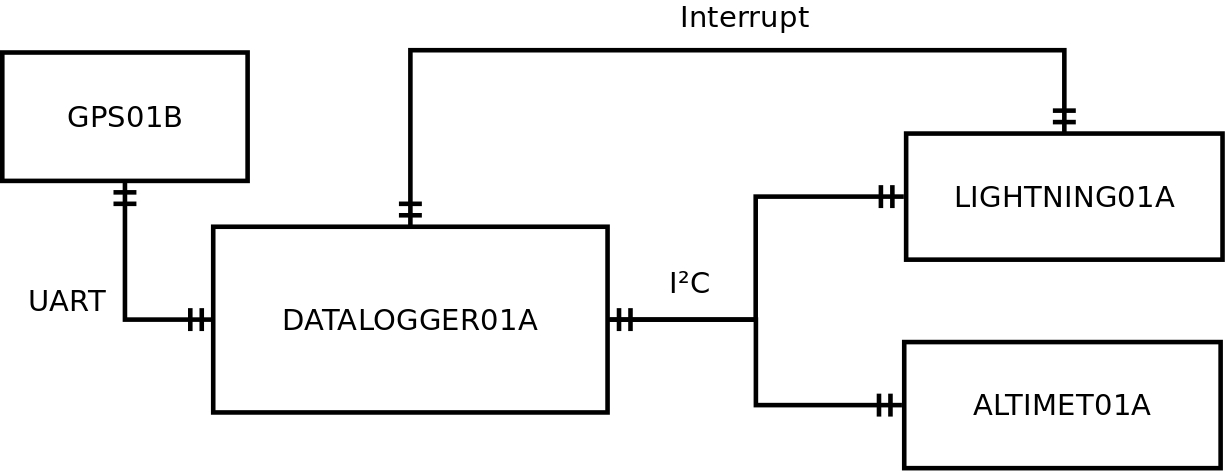
The instrument is mobile (operates from a single LS33600 cell for ≈5 days with GPS on, ~3 months without GPS), low-mass, and trivial to integrate. The relevant question is whether its proprietary classification can be used as a research-grade trigger.
Comparison with Blitzortung.org
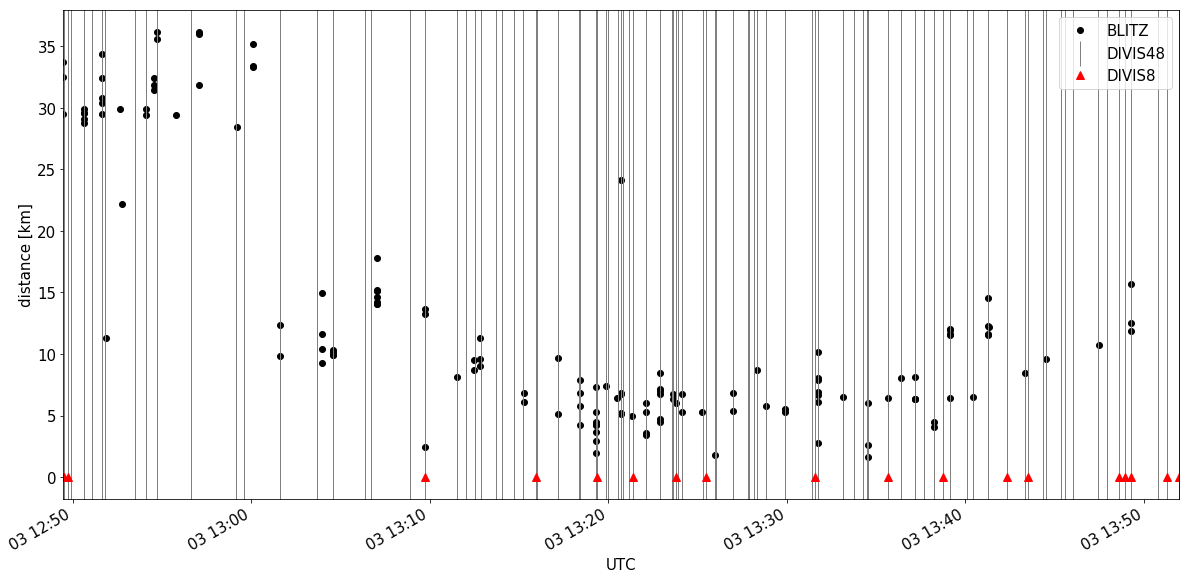
The LIGHTNING01A was field-tested side-by-side with the Blitzortung.org network across multiple thunderstorms in Czechia. Coincidences between LIGHTNING01A detections and Blitzortung-localized strikes within radii of 5, 10, 20 and 30 km were counted within a ±1.5 s window:
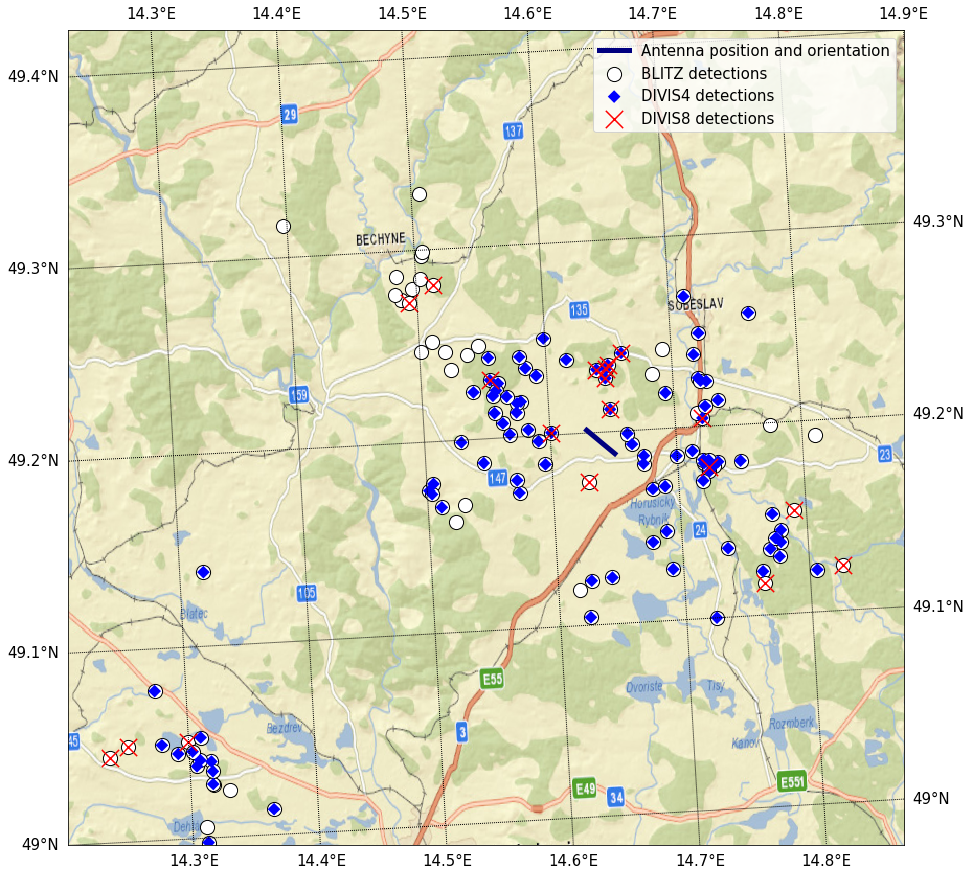
The map below shows Blitzortung detections together with the subset that also coincides with a LIGHTNING01A event (blue = DIVIS4/disturbance, red = DIVIS8/lightning):
Findings:
- LIGHTNING01A (
DIVIS48, both classifications combined) covered 94.7 % of Blitzortung strikes within 5 km of the station, and ≈ 79 % within 30 km. - The proprietary lightning-vs-disturbance classification is not reliable: only 36.8 % of Blitzortung-confirmed lightning was classified as lightning (
DIVIS8) by the chip. For trigger purposes, theDIVIS4+DIVIS8combination is therefore mandatory. - Approximately 43 % of
DIVIS4events are not registered by Blitzortung within 30 km — those are either real but beyond range, or false positives. With theDIVIS4+DIVIS8combination the false-positive rate is too high to be used standalone to gate the recording of high-rate instruments. - The latency from a rectangular test signal injected into the coil to the interrupt output is 93 ms ± 1 ms when classified as a disturbance; pulses classified as lightning emerge in only a few ms. This non-deterministic latency cannot be characterized further because the algorithm is closed-source.
When LIGHTNING01A is useful
The above caveats notwithstanding, LIGHTNING01A is useful for triggering bulk instruments that
- record long, contiguous fragments (≥ 1 s before and after the trigger), and
- tolerate substantial false-positive rates.
Typical applications: airborne dosimeters that need a coarse “thunderstorm proximity” flag, long-window data loggers, screening tools for picking storm-time intervals out of a multi-day archive. For high-speed cameras and SDR receivers, where the per-event dead time is many seconds, the false-positive rate of an AS3935 is unacceptable and a ToT detector inside the SDR (RSMS02) is the correct solution.
The directional sensitivity of the small coil antenna is slight but measurable — typically a factor 2 between the broadside and end-fire directions, observed in the spatial distribution of coincident strikes. For close lightning within a 5 km radius the effect is negligible.
Practical recipe for users
- In-storm SDR triggering (RSMS02 + camera, EFM, radiation detectors on the same vehicle): use the RSMS02 ToT trigger directly. Typical settings: threshold 10–30 mV, duration 5–20 µs, both adjustable from the web UI per channel.
- Coarse storm-flag logger (battery-operated, long deployment, no SDR available): use a LIGHTNING01A-based DIVISEK box; treat its
DIVIS4+DIVIS8outputs as a single combined detection and expect some false positives. - Reference / cross-check: pull the Blitzortung.org server feed in parallel with whatever local trigger you use. Differences in coverage between the two are informative — they tell you when your local sensitivity is mistuned.
Related publications
- J. Kákona et al., In situ ground-based mobile measurement of lightning events above central Europe, Atmos. Meas. Tech. 16, 547–561, 2023.
- J. Kákona, Detection of Electromagnetic Phenomena in the Atmosphere – Integrating Advanced Instrumentation and UAVs for Enhanced Atmospheric Research, doctoral thesis, CTU in Prague, 2025.